
The results of the quantitative socio-legal study presented in this report, titled “Assessment of the Institution of Judicial Review in Administrative Proceedings,” allow us to draw conclusions regarding the practice of applying the institution of reporting on the enforcement of court decisions. The empirical data collected has the potential to serve as a guide for the further development of Ukraine’s legal system, the improvement of mechanisms of legal liability, and the establishment of the principle of the rule of law.
The study aimed to conduct a comprehensive assessment of the current state, practices of application, and prospects for improving the institution of judicial review, particularly regarding the submission of reports on the enforcement of court decisions. The total sample consisted of 460 respondents, including judges, plaintiffs, defendants, and their representatives.

A brief overview of the findings reveals several clear trends, including the dominance of two key reasons for the non-enforcement of court decisions: insufficient funding (58%) and the lack of effective enforcement mechanisms (43%). In addition, plaintiffs and their representatives often highlight the weakness of judicial oversight after a decision is rendered.
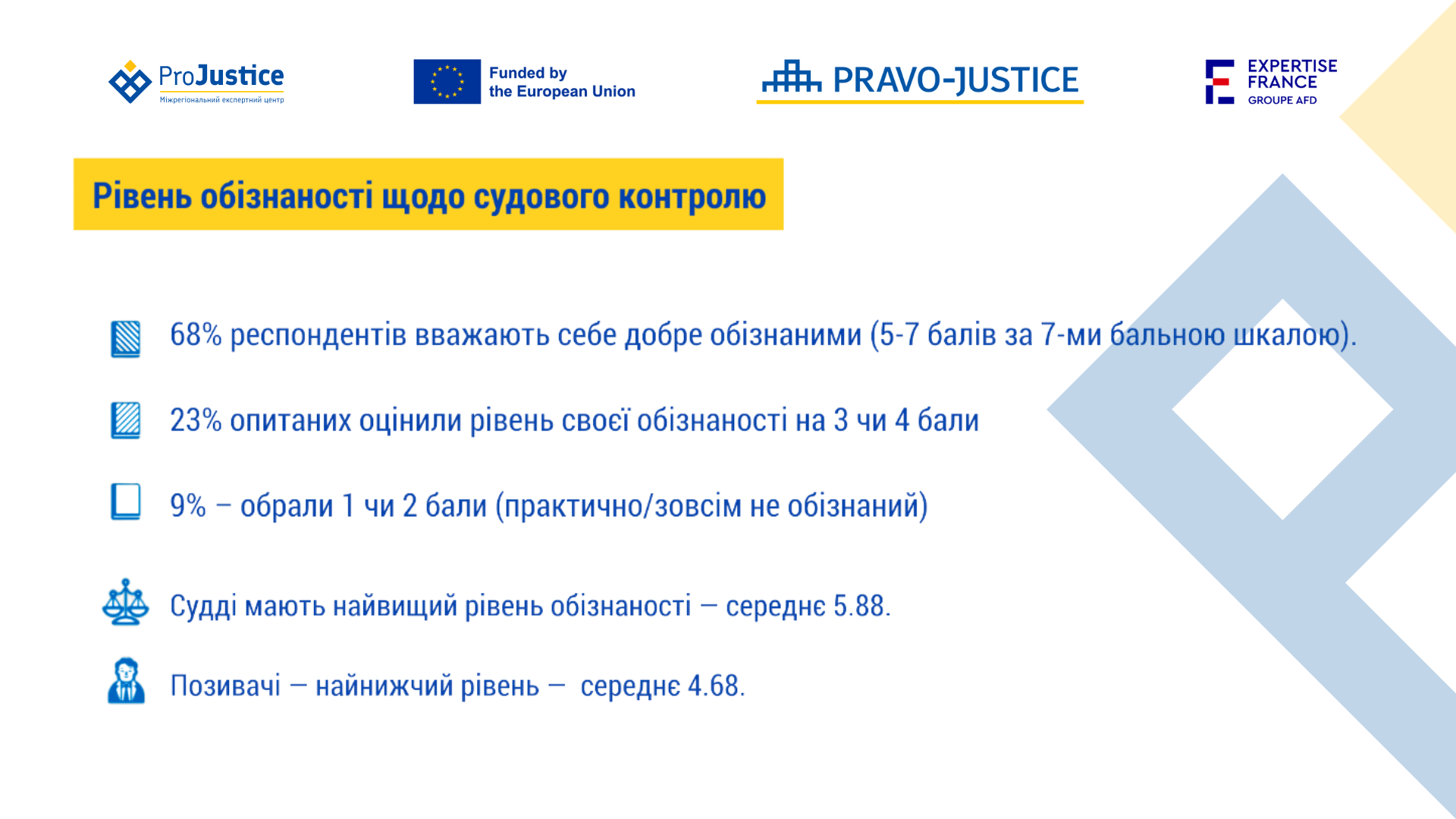
Respondents’ awareness of the institution of judicial oversight is assessed as fairly high: 68% of respondents consider their knowledge to be average or high. The reporting mechanism was most frequently used in administrative cases related to social security. At the same time, 61% of respondents either never used this procedure or did so only occasionally. In the context of civil and commercial proceedings, only one-third of respondents reported an adequate level of awareness regarding judicial review outside the scope of administrative jurisdiction.
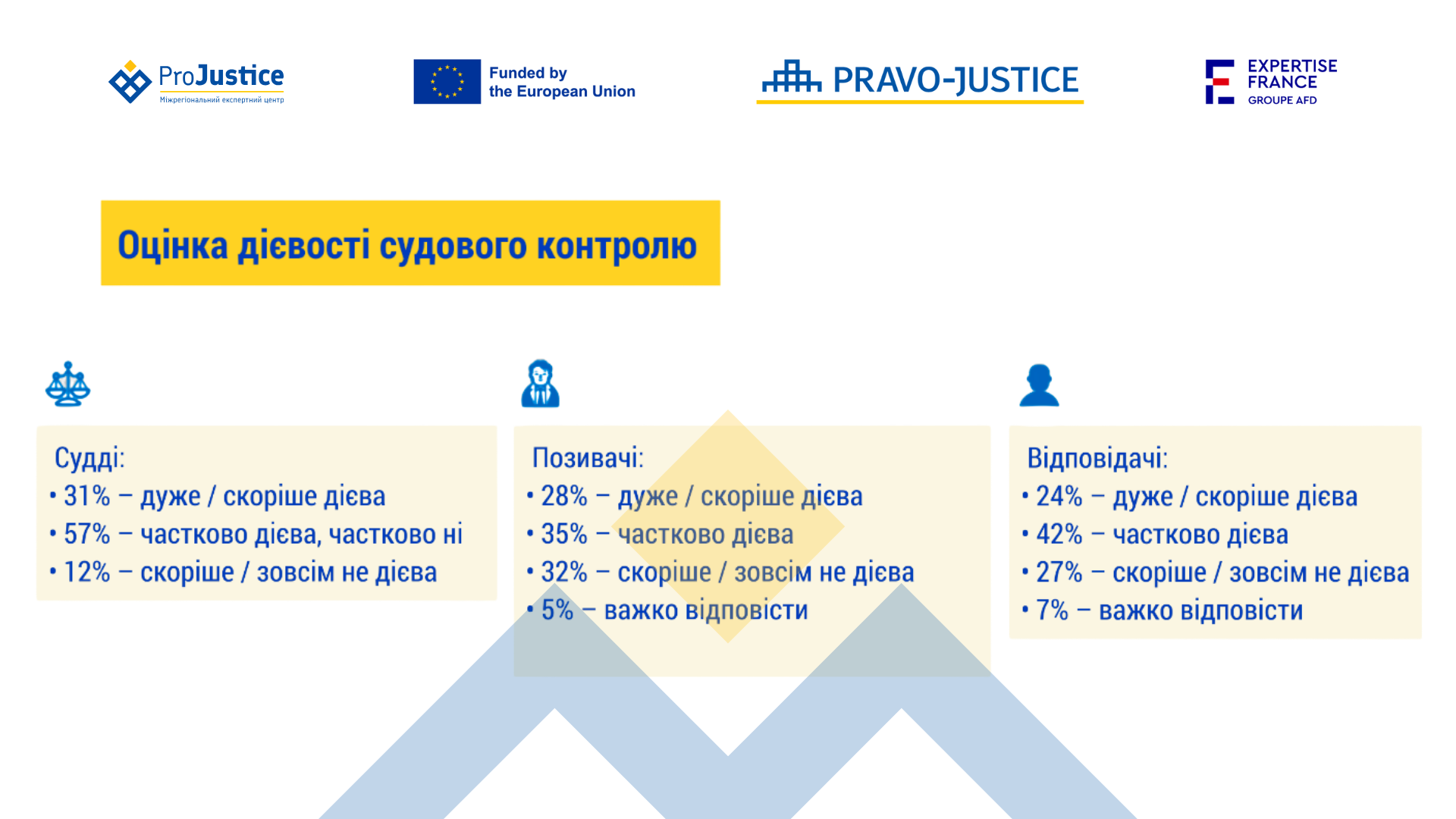
Assessing the effectiveness of judicial oversight became one of the key topics of the survey: 31% of judges and 28% of plaintiffs consider it effective. Among the main barriers to its effective implementation are the overly formal nature of reports, the passivity of the court, and the lack of personal accountability among enforcement officials. Some court decisions remain unenforced even after judicial oversight has been established.
Regarding implementation practices: 76% of judges have experience establishing judicial oversight of decision enforcement, while 35% of plaintiffs have filed corresponding motions with the court. Among defendants, 45% have faced the need to submit an enforcement report.
Judges assessed the effectiveness of the judicial oversight applied as follows: 31% consider it “very/somewhat effective,” 57% – “partially effective,” and 12% – “somewhat/not at all effective.” Plaintiffs provided similar assessments: 28% – “effective,” 35% – “partially,” 32% – “ineffective,” 5% – undecided. Among the defendants, the corresponding figures were: 24% – “effective,” 42% – “partially effective,” 27% – “ineffective,” and 7% – “difficult to answer.”
Respondents cite the following as the main advantages of the institution: additional safeguards for plaintiffs, improved accountability of government bodies, the affirmation of the rule of law, increased judicial efficiency, and greater public trust in the judicial system.
At the same time, shortcomings were identified: the formal nature of reports, the lack of personal accountability, the limited nature of enforcement tools, the overburdening of the judiciary, and the inability to effectively enforce court decisions due to a lack of funds.
Respondents also assessed the need for legislative and institutional changes. Specifically, 49% believe it is necessary to improve the provisions of procedural law regarding reporting; 47% support the introduction of a specialized procedure; 77% support the implementation of a unified electronic system for monitoring the enforcement of decisions. 32% advocate expanding judges’ powers within the scope of judicial oversight, while 33% do not see such a need, and another 33% were undecided.
Among the priority measures that, according to respondents, would contribute to improving the institution’s effectiveness are: strengthening liability for non-enforcement of decisions, including the automatic imposition of fines (44%); granting courts the authority to initiate disciplinary proceedings against officials (34%).
In addition, the study analyzed the impact of full-scale war on the application of judicial oversight. Among the main consequences of the war, respondents noted: an additional burden on courts in relatively safe regions,